
COD Seasonality in Morocco: Preparing for Ramadan, Eid, Summer and Sales

In COD in Morocco, no two weeks are alike. Ramadan, Eid, back to school, the end-of-year sales: depending on what you sell, some moments make orders explode, and others are much quieter. A badly prepared peak means unconfirmed orders, stock-outs and late parcels. A badly anticipated slow period means fixed costs running for nothing.
This guide explains how to spot your own seasons, and how to prepare your stock, your confirmation, your shipping companies, your cash flow and your costs before each peak.
The key moments of the year
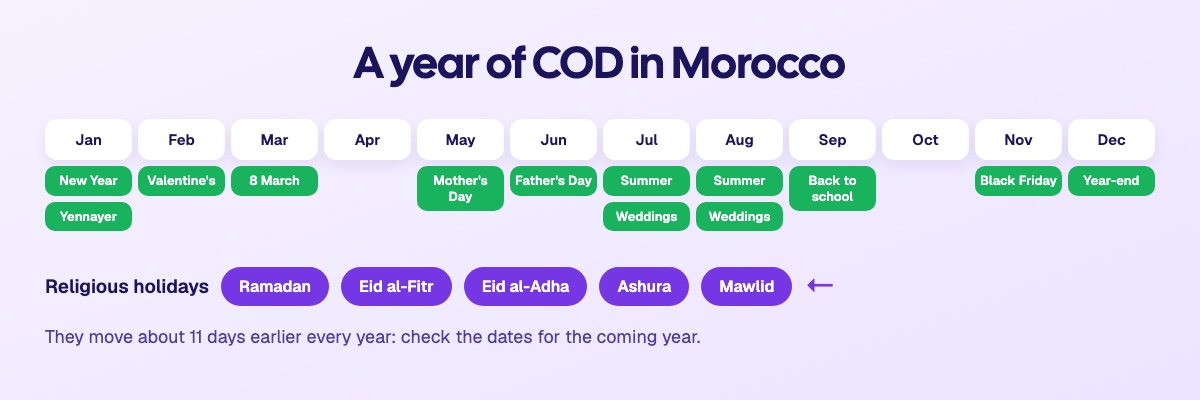
Every store has its own calendar, which depends on its products. Here are the dates and events that move purchases in Morocco, with what tends to sell most.
Fixed dates
Period | Event | What often sells |
|---|---|---|
Early January | New Year, then the Amazigh New Year (Yennayer, 14 January) | Gifts, post-holiday clearance, home items |
14 February | Valentine's Day | Perfumes, jewellery, watches, personalised gifts |
8 March | International Women's Day | Gifts, beauty, accessories |
Usually late May | Mother's Day | Gifts, beauty, home appliances |
June | Father's Day, end of the school year | Gifts, watches, accessories |
July and August | Summer, wedding season, Moroccans abroad coming home | Fashion, party outfits, jewellery, holiday products |
September | Back to school | Stationery, school bags, clothes, shoes |
Late November | Black Friday | Electronics, fashion, beauty: customers expect a promotion |
December | Holidays and end-of-year sales | Gifts, winter fashion, electronics |
Religious holidays, on moving dates
Holiday | What often sells |
|---|---|
Ramadan | Kitchen, tableware, food, decoration, then outfits for Eid |
Eid al-Fitr | Traditional clothing, shoes, gifts for children |
Eid al-Adha | Kitchen and barbecue utensils, home appliances, party outfits |
Ashura | Toys and gifts for children |
Eid al-Mawlid | Traditional outfits, perfumes, incense |
These holidays follow the Hijri calendar and move about 11 days earlier every year. Check the dates for the coming year before planning. Around the two Eids, also expect days when deliveries slow down.
1. Know your own seasonality
Other stores' key moments are not necessarily yours. Look at your own numbers from last year, week by week: how many orders, what confirmation rate, what return rate. Spot the weeks when everything overflowed, and the ones when the team was waiting for orders.
In Sendocki, the Trends tab in Analytics compares each period with the previous one, and charts can be shown by day, week or month. For a given product, the sales rhythm also shows the days and times when it sells most.
2. Prepare your stock
Order earlier the products that sell during the peak: suppliers are swamped too.
Stop advertising a product whose stock won't last: a confirmed order you can't ship costs a confirmation and an unhappy customer.
After the peak, check what is left in stock before launching a new campaign.
3. Keep confirmation going during the peak
This is often where things break: orders come in faster than the team can call, and every hour of waiting lowers the confirmation rate.
Automate the first contact. A WhatsApp message sent as soon as the order arrives, with Confirm and Cancel buttons, confirms part of the orders without a call. See WhatsApp order confirmation.
Let KENZI answer questions. During Ramadan, many customers write in the evening and at night. KENZI, Sendocki's AI agent, answers them on WhatsApp at any hour.
Keep your agents for calls. The call queue hands out customers who did not reply, with no duplicates, even with temporary staff.
Motivate the team for the period. A commission rule can be switched on for the peak, then switched off afterwards. See confirmation agent commissions.
4. Warn your shipping companies
Tell them your expected volumes, and ask for their closing days around the holidays.
Plan more frequent pickups during the peak.
If you work with several shipping companies, split parcels according to their delays by city. In Sendocki, the Deliveries tab in Analytics compares your shipping companies and your cities. See how to choose a COD shipping company.
Warn your customers about longer delays: a customer who has been told refuses their parcel less often.
5. Watch your cash flow
In COD, money arrives after delivery, then after the shipping company pays you out. During a peak, you buy more stock and pay for more advertising, while the cash from sales arrives later. Track cash collection order by order to know what is still with the courier, and plan enough to last until the payouts.
6. Costs that follow your volume
A fixed-price tool costs you the same in the middle of Ramadan and in the middle of a slow month. With billing per shipped parcel, the bill goes up during the peak, when you sell, and comes down when things are quiet. An example on Sendocki's Growth plan, with volumes made up for illustration:
Month | Parcels shipped | Sendocki bill |
|---|---|---|
Quiet month | 300 | 149 + 300 × 0.80 = 389 MAD |
Peak month | 1,400 | 149 + 1,400 × 0.80 = 1,269 MAD |
Do the maths over a whole year, with your strong months and your weak ones. See COD software pricing.
The checklist
Four weeks before
Compare with last year's numbers for the same period.
Order stock for the products that will sell.
Check that your automatic WhatsApp messages and your call queue are ready.
Warn your shipping companies and note their closing days.
During the peak
Track the confirmation rate and the delay before the first call every day.
Stop advertising products that are out of stock.
Track delivery delays by city.
After the peak
Track returns and cash collection for delivered parcels.
Switch off temporary commission rules.
Write down what was missing, for next time.
Frequently asked questions
When should you start preparing for Ramadan?
Four weeks ahead is a good benchmark for stock, messages and the team. As Ramadan moves about 11 days earlier every year, check the expected date before planning.
Should you hire for the peak?
Not necessarily. With automatic WhatsApp confirmation and KENZI for typed replies, a small team can absorb more volume. If you bring in extra staff, the call queue gives them orders one at a time, with no long training. See reducing confirmation costs.
Do returns go up after a peak?
It depends on your products and on the quality of confirmation during the peak. Track your return rate over the following weeks to find out. See how to calculate and reduce your return rate.
Key takeaways
COD peaks can be prepared: know your own seasons, plan your stock, automate confirmation, warn your shipping companies and keep an eye on cash flow. And choose tools whose cost follows your activity, so you don't pay the price of a peak during your quiet months.


