
AI Agent or Human Agent: Who Should Confirm Your COD Orders?

Do you still need a human confirmation agent when an AI can answer customers on WhatsApp? Or the other way round, can an AI really confirm an order as well as a person who knows your products?
The right question is not "one or the other". It is "who does what". KENZI, Sendocki's AI agent, and your human agent do not have the same strengths. This guide compares them point by point and shows how to make them work together.
What each one does
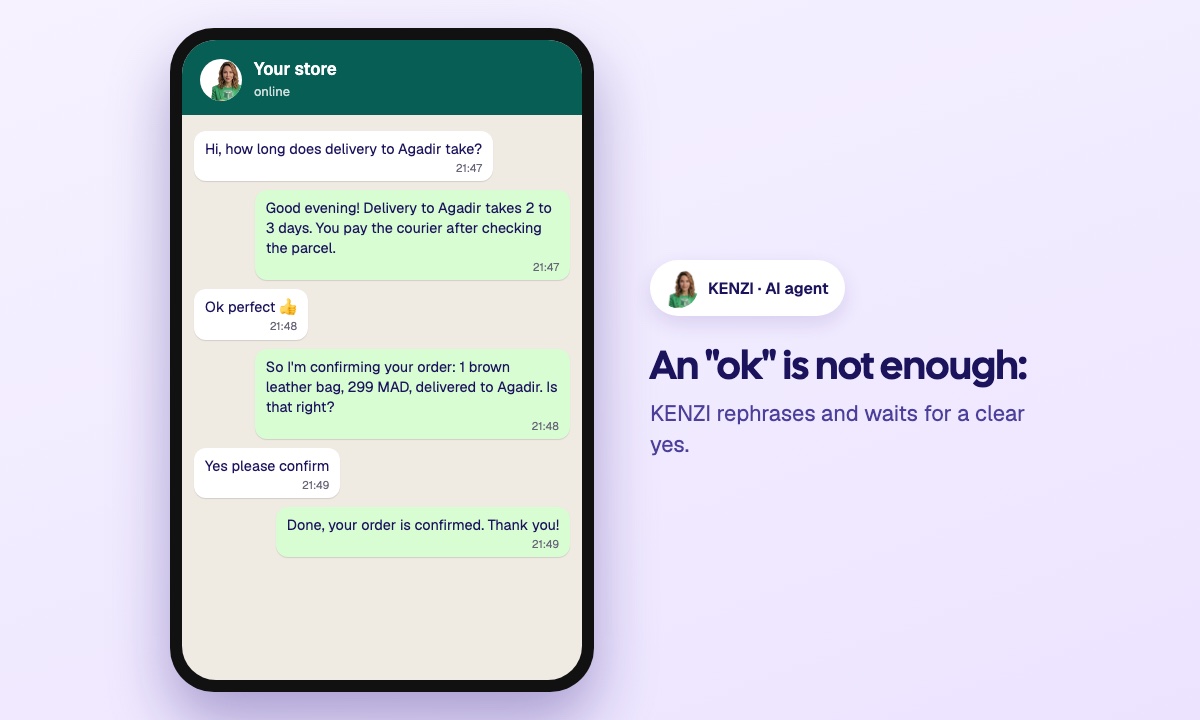
KENZI works on WhatsApp, from your own number. She confirms orders in conversation, answers questions about your products and terms, reassures the customer who hesitates, takes new orders and hands over to your team when she does not know.
Your human agent calls, calls back, negotiates, changes an order, handles an unhappy customer and decides when a situation is out of the ordinary. They know your loyal customers, your tricky products and your shipping companies.
The comparison, point by point
KENZI (AI agent) | Human agent | |
|---|---|---|
Availability | Any hour, including evenings and weekends | Their working hours |
Response time | A few seconds | Depends on their queue |
Customers at the same time | As many as needed | One call at a time |
Languages | Darija, Arabic, French | Their own |
Channel | Phone and WhatsApp | |
Customers who do not read messages | Cannot reach them by phone | Calls them |
Unusual cases and decisions | Hands over | Decides |
Prices, discounts and promises | Never invents anything | According to your instructions |
Where KENZI is strongest
Volume. She answers every customer at the same time. A spike in orders after a campaign does not create a queue.
Off-peak hours. Many customers read their messages in the evening. KENZI answers them right away, when they are available, instead of waiting for the next morning.
Repeated questions. Delivery time, size, colour, whether the parcel can be opened: she answers from your store's information, the same way every time.
Rigour. She only validates an order on a clear yes. An emoji or an ambiguous "ok" is not enough: she rephrases and asks again.
Where the human agent remains essential
The phone. Some customers only answer calls. Without a human agent, those orders go nowhere.
Changes and exceptions. Swapping a product, merging two orders, offering a goodwill gesture: these are decisions, and they belong to your team.
Difficult customers. An unhappy or suspicious customer often needs to hear a voice.
Judgement. Spotting a suspicious order, a number that comes back too often, an address that does not match the city: the human agent's experience matters.
The right model: KENZI first, the human agent next
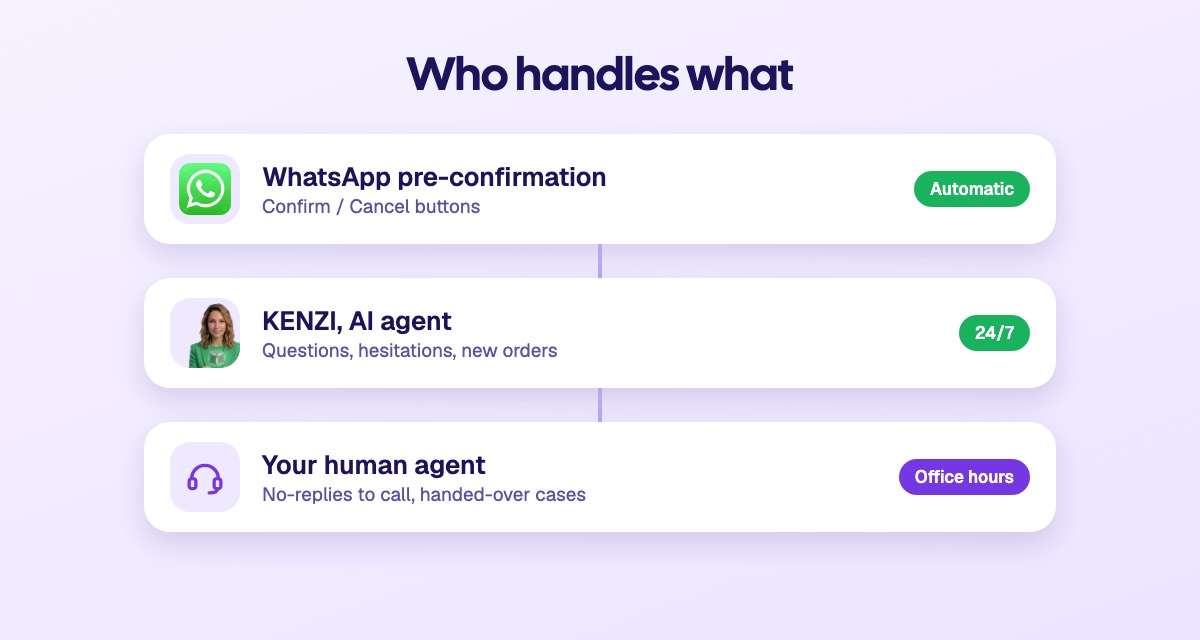
The most effective flow splits the work into three levels:
WhatsApp pre-confirmation goes out as soon as the order arrives, with "Confirm" and "Cancel" buttons. The customer who was expecting it confirms in one tap.
KENZI picks up every customer who replies with a message: she answers, reassures and confirms.
Your human agent gets the rest in their queue: customers who did not reply, to be called, and the questions KENZI passed on.
The human agent no longer spends their days dialling numbers to hear "yes". They handle the orders that really need them. That is what makes it possible to run with a single human agent where several were needed. See our guide to reducing confirmation costs.
A typical day
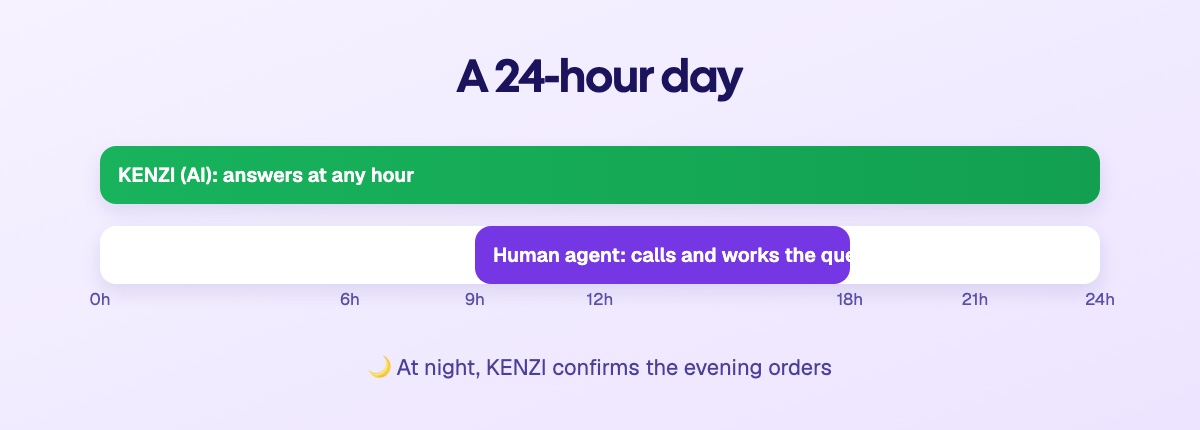
In the morning, the human agent opens their queue: the night's orders are already confirmed or cancelled, and only no-replies and handed-over questions are left. During the day, KENZI answers customers as they come while the human agent calls. In the evening, when the team has gone home, KENZI keeps answering.
How the human agent is paid in this model
If the human agent only handles the difficult cases, their commission should reward what matters: delivered orders. In Sendocki, the account owner sets the commission rules, by role, team or agent, on the step of their choice, and the app does the calculation. See confirmation agent commissions.
Frequently asked questions
Can KENZI call customers?
No. KENZI works on WhatsApp. Customers who do not answer messages are called by your human agent.
What happens when KENZI cannot answer?
She tells the customer without inventing anything and passes the question to your team, who take over the conversation.
Can KENZI change an order?
Order changes and goodwill gestures remain your team's decisions. KENZI collects the request and passes it on.
Do you have to choose between the two?
No. They complement each other: KENZI absorbs the volume and off-peak hours, the human agent keeps the phone and the decisions.
Key takeaways
KENZI does not replace your human agent: she is the first level of your confirmation. She answers everyone, straight away, at any hour. Your human agent, freed from repetitive calls, focuses on what an AI does not do: calling, deciding and handling the cases that are out of the ordinary.


